



An 18-month cycle of 50 days of strict lockdown followed by 30 days of easing could peg SA’s Covid-19 fatalities to just over 9,000 and allow the health system to cope, says an international team of researchers.
SA was one of 16 countries in which three scenarios were modelled by the Global Dynamic Interventions Strategies for Covid-19 Collaborative Group, led by University of Cambridge global health epidemiologist Rajiv Chowdhury.
The team was particularly interested in the difference between strategies aimed at mitigation and those aimed at suppression.
Mitigation measures reduce the number of new infections, but at a relatively slow rate. They include general social distancing, hygiene rules, case-based isolation, shielding of vulnerable groups, school closures and restricting large public events.
Suppression measures lead to a faster reduction in the number of new infections by applying additional interventions such as strict physical distancing, including lockdown.
Chowdhury said the team found a continuous three-month lockdown would reduce new cases to near zero in most countries. But they would also experience significant job losses, financial insecurity and social disruption.
An alternative may be to alternate strict measures with intervals of relaxed social distancing, and the researchers wanted to work out the ideal frequency and duration of these interventions.


“This should allow them to buy valuable time to shore up their health systems and increase efforts to develop new treatments or vaccines,” he said.
“There’s no simple answer to the question of which strategy to choose. Countries — particularly low-income countries — will have to weigh up the dilemma of preventing Covid-19 related deaths and public health system failure with the long-term economic collapse and hardship.”

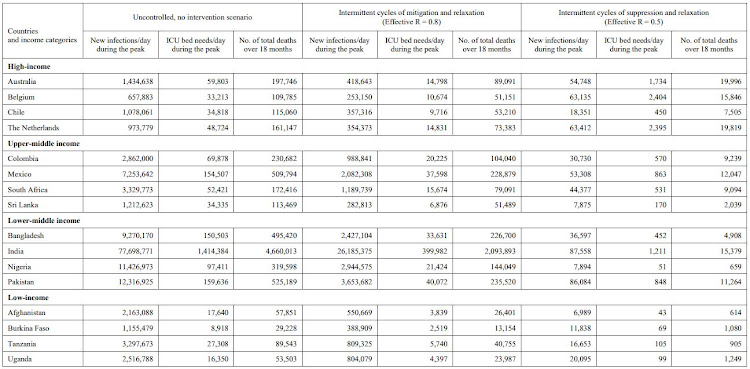
First, the team also modelled the impact of imposing no measures. The number of patients requiring treatment in intensive care units would quickly exceed the available capacity for every country. The pandemic would last about 200 days in SA but kill 172,416 people.
The it modelled a cycle of 50-day mitigation measures followed by a 30-day relaxing. This would be likely to reduce the R number (the number of people each infected individual goes on to infect) to 0.8 in all countries.
However, it would still be insufficient to keep the number of patients requiring ICU care below the available capacity. In SA, this approach would lead to 79,091 deaths over 18 months.
The final scenario would reduce the R number to 0.5 and keep ICU demand within national capacity in all countries.
Since more people would remain susceptible at the end of each cycle of suppression and relaxation, the approach would lengthen the pandemic beyond 18 months. In SA, there would be 9,094 deaths.
BY: BY